Browse U9, U10, U11, & U12 Soccer Drills and Soccer Practice Sessions
Under 9Under 10Under 11and Under 12 Soccer Drills (U9U10U11& U12 Soccer Drills)U9 U10 U11 U12 Soccer Practice Sessions
When coaching Under 9, Under 10, Under 11, and Under 12, the player's motor skills are becoming more refined. Most players can stay on task at a greater length allowing you to extend your practices to an hour and a half or, in some instances, competitive team environments, two hours. You will notice skills starting to emerge, and the repetition of technique is essential. Coaches should continue positive reinforcement as peer pressure is starting to become an issue.
With the player's technique learned at an earlier age is now time to refine these skills with an introduction to basic tactics. Small-sided games will become your primary teaching means. With small-sided games such as 1v1, 2v2, 3v3, and 4v4, players will receive tons of touches while focusing on less complicated tactics than a 11v11 match.
My #1 piece of advice is to play small-sided games and put an emphasis on creating a competitive environment as much as possible. This will keep the small-sided games fun for the players and teach the game itself.
The soccer drills listed below are age specific soccer drills for Under 9 (U9, U-9, 9 and Under), Under 10 (U10, U-10, 10 and Under), Under 11 (U11, U-11, and 11 and Under), Under 12 (U12, U-12, 12 and Under).
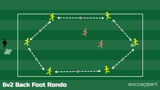
This 6v2 rondo keeps eight players busy in one small grid and teaches a habit every good passer needs. Players cannot pass across the grid. The ball can only go to the teammate next to them, on the left or the right. That rule forces players to open up and receive with the back foot so the ball keeps moving around the grid. I like this version for bigger groups because six attackers give the ball plenty of places to go, but only if players set their body shape early. A player who faces the passer gets closed down fast by two defenders. A player who opens the hips and takes the first touch across the body moves the ball on with no fuss. You will see quicker ball speed, sharper first touches, and players who look before they receive. The two defenders get a real workout too, and they learn to press as a pair.
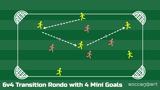
This 6v4 rondo turns a simple possession game into a real fight for the ball. Six attackers keep the ball and score by stringing passes together. Four defenders hunt it down, and the second they win it they can score in any of the four mini goals in the corners. That one twist gives both teams a reason to work. The six learn to spread out, pass with purpose, and receive on the move under real pressure. They also learn the hard lesson that losing the ball costs them, so they must react at once and win it back. The four learn to press together, win the ball, and attack fast before the other team recovers. I have run games like this for years, and the best part is how close it feels to match day. Possession, defending, and transition all happen in one grid with no lines and no waiting.
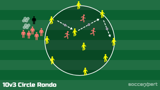
This circle rondo gets your whole team working in one game. Eight attackers ring the circle and two more play in the middle. Together they keep the ball away from three defenders who come in as a unit. For the attackers, it is all about sharp passing, a clean first touch, and using the two middle players to break pressure. For the defenders, it is one of the best ways I know to teach pressure, cover, and balance. One player closes the ball. One covers behind. One balances and shuts off the far side. Three defenders cannot win the ball by chasing alone, so they must work as a team. When they win it, three fresh defenders sprint in and the game rolls on. The pace stays high, nobody stands for long, and every player gets a turn on both sides of the ball.
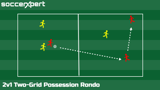
This drill sharpens your team's ability to keep the ball under pressure and use support. Two attackers face one defender in a tight grid. That is a real test of quick touches and quick thinking. When the defender wins the ball, they looks to link with his own attacker in the next grid to keep his team involved. Your attackers must think fast too. They can use the player in the next grid as an out ball, but that player only gets one or two touches. This forces sharp first touches, quick scanning, and constant movement to support the ball. It is a great drill for players who need work on tight combination play, fast decisions, and staying composed under pressure.
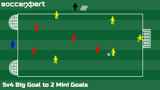
This game-like drill creates a high-tempo match situation to challenge both attackers and defenders. Attackers learn how to break through a compact defense to create finishing chances on the big goal. Defenders focus on applying pressure, staying compact in central spaces, and protecting the penalty area. When defenders win the ball, they must transition immediately to find the two mini goals or connect with the neutral target. The neutral player keeps the pace high and gives both teams an outlet to reset and switch the attack.
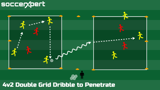
This drill builds the courage to dribble forward and the vision to combine once you get there. Most young players learn to keep the ball. Fewer learn when to carry it into space on purpose. Here, attackers hold a 4v2 advantage in one grid until a gap opens. Then one player has to make a bold read: drive the ball across open space into a second group and keep the play alive. It is a great tool for coaches who want players who dribble with a purpose, not just to beat a defender for the sake of it. Along the way, players practice supporting angles, scanning before the ball arrives, and staying patient in tight numbers-up possession. Add pass or touch restrictions once players get comfortable, and this drill turns into a real tactical test of speed of play and decision-making under pressure.
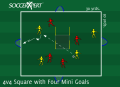
This drill develops players' vision and awareness by forcing them to constantly scan and recognize which goals are open for attack. The requirement to pass through the center poles before scoring teaches patience in possession and rewards teams that can control the ball and pick the right moment to penetrate. Players learn to open up their body position to see the entire field, including teammates making backside runs away from pressure. The four goals create constant decision-making about which direction to attack based on where defenders are positioned. Quick transitions become essential because once a team completes the pass through the center, they must immediately identify and attack an open goal before defenders can recover. This setup mimics games in which teams must recognize when to keep possession and when to strike quickly, and it rewards players who can switch the point of attack rapidly.
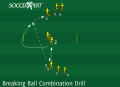
This drill teaches players how to play accurate breaking balls into space and make well-timed runs to receive them. Players will work on combination play through quick 1-2 passes, then focus on the weight and timing of through balls. The receiving player learns when to make their run and how to time it with the pass. This drill builds the connection between passer and runner that's crucial in breaking down defenses during games.
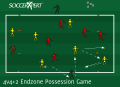
This drill develops players' ability to keep possession under pressure while moving the ball quickly and effectively. Players learn to scan the field, find open teammates in different zones, and make smart decisions about when to pass and when to dribble. The endzone players teach awareness of supporting options behind the defense. Neutral players on the sides create overloads that mirror real game situations. Players work on their first touch, receiving skills, and passing accuracy while constantly moving to create passing lanes. The progression from simple possession to scoring through the endzones builds complexity as players improve.
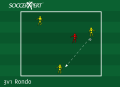
This drill builds the foundation of possession soccer by teaching players how to keep the ball in tight spaces. Players learn to create good angles of support, move intelligently without the ball, and position their bodies correctly when receiving. The small grid forces quick decisions and sharp passing. Attackers practice opening their hips to see the whole field and using their back foot to receive passes smoothly. The drill teaches deception through body feints and eye contact that mislead the defender. Players develop the speed and accuracy needed to move the ball before pressure arrives. The consequence of becoming the defender when you make a mistake keeps everyone focused and accountable. This simple but effective drill appears in training sessions from youth levels all the way up to professional teams.
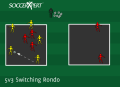
This drill trains players to recognize when possession is lost and react instantly by switching fields of play. The attacking team learns to keep the ball under pressure in tight spaces while the defending team works on winning possession and immediately playing forward. The switching element teaches players to read the game and anticipate transitions. Players must communicate who stays and who goes when the switch happens, building decision making skills under pressure. The numerical advantage for attackers creates confidence in possession while defenders learn to press intelligently when outnumbered. Moving between grids forces players to stay mentally engaged even when they're not directly involved in the current action. This back and forth rhythm mirrors real games where play shifts from one area of the field to another.
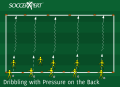
This drill improves a player's ability to protect the ball while dribbling under pressure. It teaches awareness, quick reactions, and body positioning to maintain possession against a defender.
 Medium

 Premium