Soccer receiving and turning drills to improve player's 1st-touch that often determine the direction of the attack.
soccer receiving drillssoccer receiving and turning training sessionsreceiving in soccerkids soccer turningturning receiving in youth soccer
Receiving the ball effectively is key to maintaining possession and setting up successful plays in soccer. This page offers drills to help players improve their first touch, control, and positioning under pressure.
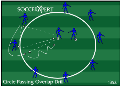
The circle passing overlap combination drill will focus on passing, combination play, overlapping, playing with speed, and playing to feet. This combination drill is an excellent passing warm-up drill that can be a great start to a passing practice that incorporates overlapping.
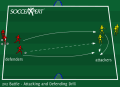
This 2v2 soccer attacking and defending drill focuses on the attacker's decision to dribble, pass, or shoot. From the defensive side, they must quickly close down the attackers and deny space.
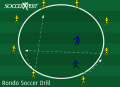
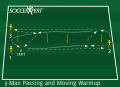
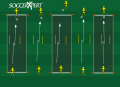
This soccer drill sharpens short-range passing, encourages constant movement after the pass, and prepares players physically and mentally for training. It reinforces clean technique and fitness through repetition.
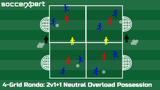
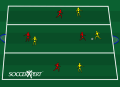
This drill builds two skills at once: tight possession play and the scanning habit every good midfielder needs. Attackers work 2v1 in a tight grid, so they must move the ball fast and support each other well. The real teaching point sits with the two neutral players. They have to read the game across two grids at once and decide, on their own, which team needs help right now. That is a decision soccer players make every match, and this drill forces it over and over in a small space. When a defender wins the ball, the drill flips instantly into a fast counter-attack on a small goal, so players also learn to transition the moment possession changes. Keep score with the point system and players will fight for every pass and every turnover.
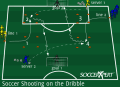
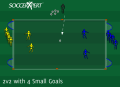
This drill enhances small-group play by developing combination play, defensive communication, and finishing under pressure. Players work on quick transitions between attack and defense in a game-like setting.
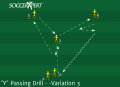
Develops players' ability to execute quick one-two passes, play accurate long balls, and transition into new positions efficiently. Encourages decision-making and proper body positioning for receiving and distributing passes.
This drill helps players develop passing accuracy, weight of pass, and first-touch control. It also reinforces teamwork and focus while progressively increasing difficulty by narrowing the passing gate.
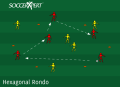
The Hexagonal Rondo drill focuses on quick passing and movement within a six-sided grid, emphasizing control and spatial awareness. Players work to maintain possession by creating passing angles and exploiting gaps in the defensive shape. The objective is to enhance technical precision, quick decision-making, and fluid team coordination.
This 4v4 drill is great for improving shape and positioning. Each player has their own responsibility: 1) attacker/target player stretches the field closer to the goal they are attacking. 2) winger players stretch the width of the field. 3) defensive player gives support to wingers and target player while staying the last man.
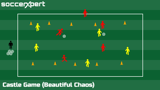
This game is chaos on purpose. Two balls are live at the same time, so players cannot lock onto one thing and switch their brain off. They have to scan, talk, and decide fast. That is the whole point. Each team guards five cones on their own end line. Each team tries to knock over the other team's cones with the ball. Knock one down, sprint it back to your castle, and it belongs to you. Simple rules, and the players get it in about thirty seconds. What you get out of it is much bigger than the rules suggest. Players learn to keep their head up because a second ball can hit them from behind. They learn to pick a pass instead of blasting it, because an accurate ball knocks a cone over and a wild one does not. They learn to shift from attack to defense in a heartbeat, since both happen at once. And the sprint rule turns this into real conditioning without a single line drill. Nobody stands around. Nobody asks how much longer. Use it as a warm-up, a mid-session energizer, or the last twenty minutes when legs are tired and you still want quality touches. It fits U6 all the way to adults. You only change the grid size and the number of balls. Coaches, resist the urge to over-coach this one. Let it get loud. Step in for a quick word, then let them play. The best learning here happens on its own, and the kids will ask for it again next week.
 MEDIUM

 Premium